
HIL Simulation
Our digital twins can be coupled to a PLC running the control software of a machine. This allows you to test the control software, without using the real machine. This type of testing is known as Hardware-in-the-Loop (HIL) simulation. HIL simulation is typically applied when the real machine is not available or very costly to use.
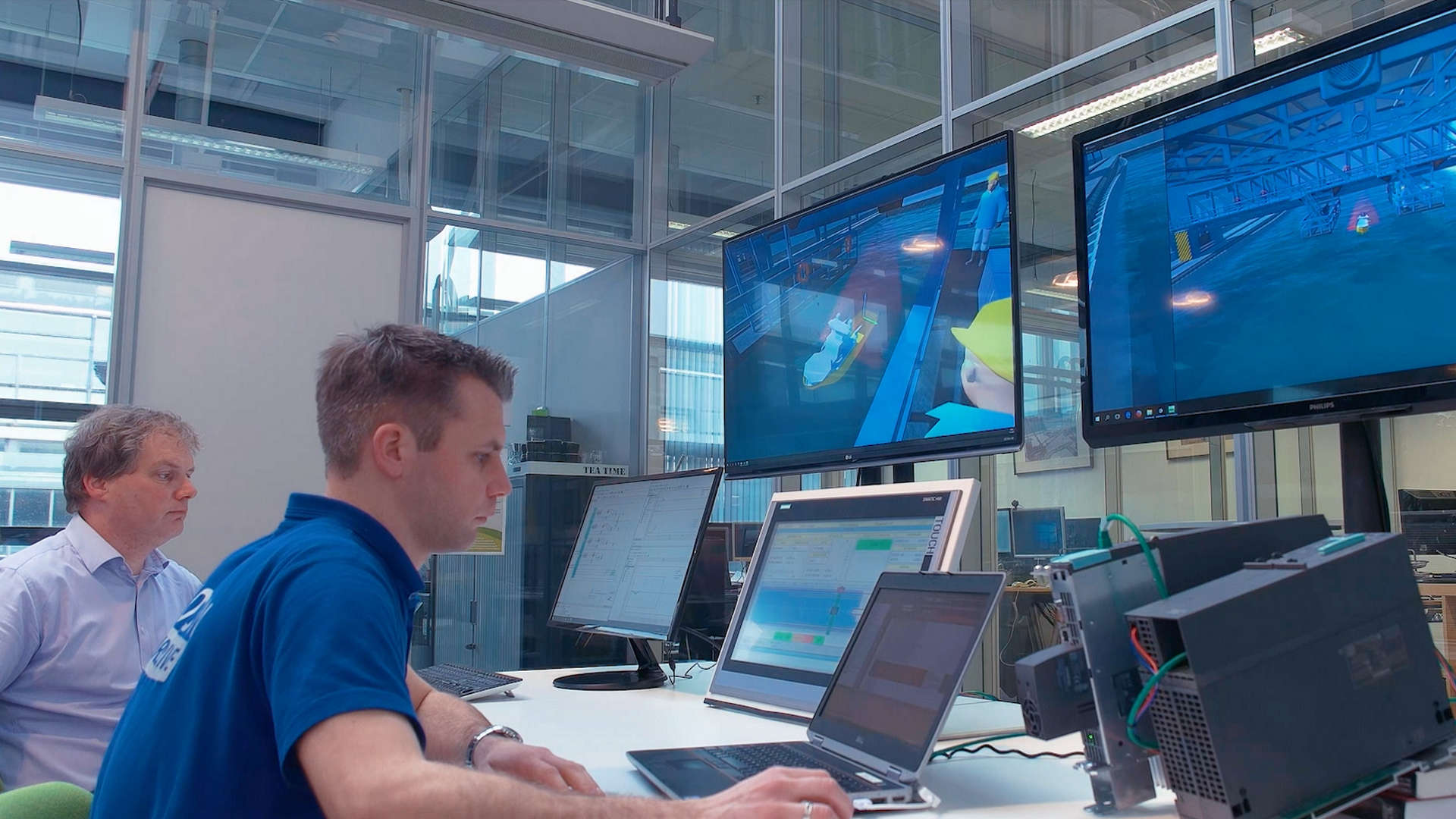
What is HIL testing?
Hardware-in-the-Loop (HIL) simulation is a technique that is used for testing control systems. Carrying out a HIL simulation to test a control system is called HIL testing.
The machine or physical part of the system (which we call the plant) is normally connected with the control system, through actuators and sensors. With HIL testing the plant is replaced by a simulation of the plant (which we call the HIL simulator). If the HIL simulator is designed well, it will accurately mimic the plant, and can be used to test the control system. Some HIL simulators are equipped with 3D visualization and represent the plant so well that they can be used for training. These HIL simulators are called training simulators.
Setup
A HIL simulation set up consists of a PC running the digital twin connected with a PLC running the control software.
-
A keyboard, mouse and HIL HMI are used to start the simulation and choose a test.
-
An operator panel and operator HMI are used to give the machine input during the test.
-
The machine behaviour is shown in the displays using in 3D animations and plots.
PLC
We couple our digital twins to your PLC using one of the following communication protocols to exchange data:
-
TCP/IP
-
UDP
-
OPC-UA
-
CAN
-
Modbus
-
Bachmann M1COM,
Most of the PLC brand support these protocols. We have good experience with Siemens (S7, S7-1500), Beckhoff, Bachmann and Rockwell.